

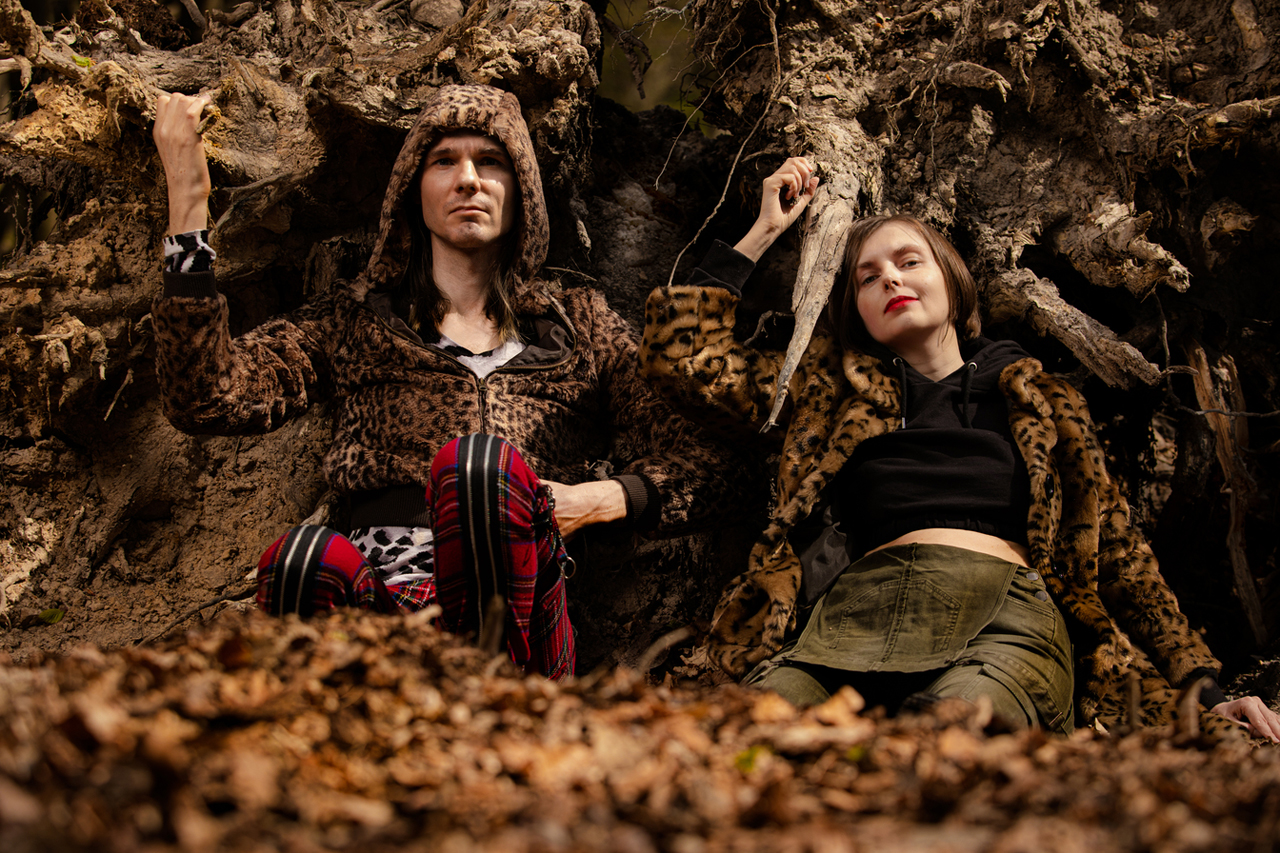
Experimental art-electronica duo tAngerinecAt have been making a name for themselves with their challenging music, that explores the effects of trauma and the lasting effects on the psyche. Comprised of Eugene Purpurovsky and Paul Chilton, the pair fuse pain and politics as expressed through the combined use of traditional central European folk styles and instruments such as droning hurdy-gurdy put to increasingly unsettling, serrated beats.
Their latest release is ‘House Of Shards’; Purpurovsky’s painful personal account of their experiences while fleeing the Ukraine as a queer multi-ethnic refugee. Cacophonic, yet somehow cathartic, their single unravels the terror of having your life shattered and struggling with the broken pieces of self.
‘House Of Shards’ will also feature on their next full-length record, revealed to be a concept album titled Glass. The lacerating song is presented by a powerful video, scripted by Purpurovsky, and filmed with cinematographer Ray Moody. FMS spoke to tAngerinecAt about the new single, their upcoming album, and the creative process behind creating their own distinct sound.
“The lyrics of the song are Eugene’s interpretation of the dream as a desire to remember, rethink what happened and be liberated from the feeling of being split, transforming trauma into experience and wisdom.”
Unsettling and deeply effecting, tell us about the meaning behind new song ‘House of Shards’? “House of Shards is based on Eugene’s dream about a house where in each room objects from the past are mixed randomly with the present. There are cracks in the walls of the rooms where the light gets in. Eugene climbs higher and higher up the staircase into different rooms and the cracks in the walls get bigger and bigger in each room until he reaches the final room that has a wall completely missing. He looks out across a starry path leading into a golden town in the clouds.
“The lyrics of the song are Eugene’s interpretation of the dream as a desire to remember, rethink what happened and be liberated from the feeling of being split, transforming trauma into experience and wisdom. It is a kind of ceremony similar to ancient practices, replete with many symbols, philosophical and psychological implications. This feeling is reinforced by ritual motifs (especially at the end where Eugene plays hurdy-gurdy accompanied by the echoes of his own voice) and movements and the use of such elements in the video as photographs of grandparents to express gratitude and use of authentic Ukrainian garments hung in the forest room.
“The forest symbolizes somewhere out of time and a place of meeting with ancestors. The absence of walls at the end symbolises freedom and reaching the highest point after climbing the stairs for a long time, and the sea symbolizes becoming whole and complete. Now nothing is hindering you and you are one on one with the sea and yourself. The golden town in the distance symbolises a new beginning that will be more conscious, mature and happy. It is a ceremonial attempt to collect fragments of personal and generational history into a single whole as a process of healing from trauma and a journey into the self.”
“We have something to say, and we use different techniques and styles to create an atmosphere that allows us to communicate that to the audience.”
‘House of Shards’ is accompanied by a truly remarkable video which really amplifies the unsettling elements of the music. What was is like making it? “Actually it was a lot of fun making it! It was especially interesting creating the forest room and putting out all the props that we had prepared, and the result really felt quite magical. We had a basic script but there was a lot of improvisation as part of the process.”
Repurposing traditional instruments to be used for savage post punk with a dark electronica edge; how did you pioneer your distinct sound? “We produce electronic music but as we are also multi-instrumentalists who have played and listened to different kinds of music from childhood, we bring organic instruments and all our influences together to create something that we enjoy at that moment. We don’t think about genre. Our music is built around the lyrics, even if the music was originally a catalyst for the lyrics. We have something to say, and we use different techniques and styles to create an atmosphere that allows us to communicate that to the audience. In some way, this is connected to Eugene’s theatrical training. For example, if there is a punk element, it comes from authentic emotions and anarchist views rather than an attempt to follow genre. We literarily create our own world that we would like to see!”
It’s hard to categorise your style and impossible to pin you to a genre. Do you find it’s hard to get noticed with no obvious peers or specific scene to be presented with or do you enjoy the freedom of forging your own path? “It’s really difficult for us to connect with industry people because there is no scene at the moment where we belong. This is also related to cultural differences that effect our image and outward representation. On one hand, it’s impossible to fit in if you were born and grew up in different surroundings and have different experience and influences. On the other hand, it would be easy to imitate but wouldn’t that be boring for us and others? And our authenticity, honesty, creativity and originality is actually what makes people keep coming back to our shows despite us not belonging to a particular scene.”
“This album will be dedicated to everyone who is made to feel like they don’t belong, who are always on the road and looking for a home, and to artists who don’t have a scene like us.”
You describe your next album, Glass, as a concept album. What are the overriding themes and ideas of the upcoming record and how can we expect it to sound? “Our upcoming album, Glass, is based around Eugene’s personal life experiences as a neurodivergent person, severe trauma, acute poverty and Chernobyl disaster survivor, and a queer multiethnic refugee activist from Ukraine. We originally recorded us breaking a wine bottle on a stone floor to use in our previous single ‘Something Broke Inside’ because we wanted to use the sound of glass smashing as an integral part of the song. What better way to show something breaking than to actually break something? We altered the sample with different effects, and we decided to make it a feature of all the tracks on the album in some way including ‘House Of Shards’. It creates a very intense atmosphere, and the story behind each track is like one more shard of glass that connects together to make a whole.
“Incidentally in the video for ‘House Of Shards’ there is a broken mirror (in some scenes it’s not broken). It was broken by mistake by one of the crew, but it looks great in the video this way. There will also be an anti-fascist theme against the dehumanization of certain social groups that correlate to the abandonment of nature and imposing of hierarchy, and one collaborative track with Norwegian artist, Runa de Luna, whose experience of being non-binary and neurodivergent also resulted in exclusion from society and being labeled as ‘other’. This album will be dedicated to everyone who is made to feel like they don’t belong, who are always on the road and looking for a home, and to artists who don’t have a scene like us. We hope that this album will be liberating for all of us!”
How will tAngerinecAt be spending the final months of 2021 going into the new year? “We are moving to Wales at the end of October, will be setting up our studio there and working hard to finish Glass, which will come out on vinyl in Autumn 2022, and which is partly funded by Help Musicians.”
‘House Of Shards’ is out now.
Photo: Ray Moody